
Rugby match balls


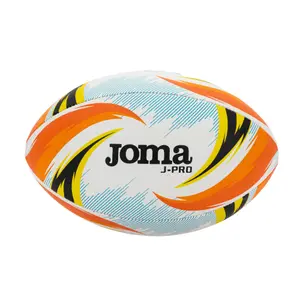


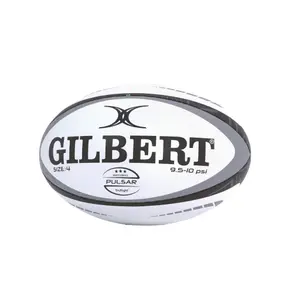
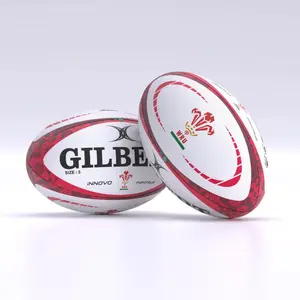
This page brings together the Match Balls for rugby: competition balls, models in the colours of clubs and nations, development balls, and versions tailored for younger players. You'll find everything you need to play, gift, or equip an entire team.
The ball is the only object that the whole team touches for eighty minutes, and its quality is felt from the very first pass. Here is its history, what distinguishes a true match ball, and how to choose the right size.
From a pig's bladder to a synthetic ball
The rugby ball owes its shape to a historical accident rather than a deliberate choice. In 1823, a shoemaker from the small English town of Rugby, William Gilbert, begins to make balls for the nearby school, which would later give its name to the sport. His balls are made from panels of leather stitched around a pig's bladder, which was inflated by mouth. Their shape, more elongated than round, did not conform to any rules: it simply stemmed from the morphology of the animal organ inside.
The technical turning point comes around 1862, when Richard Lindon, another manufacturer from the town, replaces the pig's bladder with a rubber chamber. The new material is too hard to be inflated by mouth, prompting him to invent a brass pump for the occasion. The oval shape, previously tolerated, becomes mandatory in 1892 by decision of the English federation, thus establishing the silhouette of the ball for good.
The last major change dates back to 1980, with the abandonment of leather in favour of waterproof synthetic materials. Leather had a major drawback: it absorbed water, and a soaked ball could double its weight during a rainy match, becoming nearly impossible to pass or kick. The name of Gilbert has remained associated with the rugby ball, with the brand still among the references in top-level competition.
Match ball or training ball
To the eye, there’s not much to distinguish the two, yet it’s a difference that costs and can be felt. A match ball is made with a much tighter tolerance in shape. Its shell and bladder are designed so that the bounce remains predictable and the trajectory does not deviate in flight, which is extremely important for kicking as well as long passing. It’s the ball you expect to behave the same way every time, regardless of the game phase.
A training ball prioritises another aspect: durability. It is designed to withstand hundreds of passes per session, receptions on hard ground, and repeated abrasion on synthetic or rough pitches. Its shell is thicker, its grip more durable, and it can be left at the side of the pitch in the rain without complaint. It would be a shame to wear out a match ball with this kind of use, which would ruin it in just a few weeks.
Most clubs therefore work with the two: a stock of training balls for the week, and a few match balls reserved for the weekend. Brands like Gilbert, Berugbe, or Rebond are included in the stock selection.
Choosing the right size according to age
The rugby ball comes in several sizes, and the choice is not about comfort but about learning. The size 5 ball is the adult rugby ball: international regulations define it as measuring between 28 and 30 centimetres in length and 58 to 62 centimetres in circumference at its widest point. This is the ball used by seniors and in the oldest categories of youth players.
The size 4 ball is used for the intermediate categories, typically for those around ten to fourteen years old. The size 3 ball is reserved for the youngest players, approximately between five and nine years old, whose hands simply cannot grip an adult ball.
This last point is crucial. The spiral pass, a foundational move in rugby, requires holding the ball in one hand while spinning it at the moment of release. A child given a ball that’s too big cannot achieve this: they compensate by pushing it with both hands, developing a bad habit that takes years to correct. Respecting the appropriate size is therefore the best service to provide to a young player.
The grip, what makes the difference in the rain
If there’s one criteria that really distinguishes one ball from another, it’s the grip. The surface of the ball is covered with protrusions whose shape, height, and density vary from model to model. They allow you to hold the ball in one hand, which is essential for passing, sidestepping, and all the phases where you can’t afford to hold it against your body.
In dry weather, almost all balls hold well. It’s in the rain, mud, or on a soaked pitch that the discrepancies become apparent. Some models are specifically designed for wet weather play, with more pronounced protrusions and a surface that sheds water rather than retaining it. In an area where winter matches are often played in the rain, this is a criterion worth prioritising.
However, the protrusions have a lifespan. They gradually round off with use, and a ball that has been used extensively becomes smooth to the touch, then slippery as soon as it gets wet. This is usually a signal that it’s time to relegate it to training or to replace it.
Properly inflating your ball
Inflation is the most neglected adjustment, yet it entirely conditions the behaviour of the ball. International regulations set a pressure ranging from 65.7 to 68.8 kilopascals, and each manufacturer prints their recommendation near the valve. It’s this that should be followed, using a gauge rather than the thumb pressure, which can be misleading.
An over-inflated ball becomes hard, bounces unpredictably, and can hurt on reception, especially to the fingers. An under-inflated ball deforms on foot impact, loses its flight trajectory, and ruins any attempt to play a precise kick.
One last detail, often overlooked: the inflation needle should be moistened before being inserted into the valve. If pushed in dry, it rubs against the inner seal, gradually damaging it, and eventually causes a slow leak that renders the ball unusable.
Choosing by brand
Each manufacturer has its page, making it easy to compare ranges and finishes.
- Gilbert, the historic manufacturer born in Rugby in 1823, whose balls have accompanied the game since its beginnings.
- Canterbury and Errea, two equipment suppliers present across all player kit, from jersey to ball.
- Berugbe, Rebond, and Force XV, three well-established French brands in club rugby.
- Joma and Rhino complete the selection.
To equip a team, ball bundles are significantly cheaper per unit than separate purchases. The national balls and club balls are more aimed at supporters, while mini balls make lovely gifts to give or get signed.
Where to find the best deals
Several sections of the site make it possible to find a ball at a better price all year round. The equipment deals gather the current selected offers, while the equipment clearance collects discontinued items that will not be restocked, often an opportunity to grab a match ball at training ball prices.
The key shopping times then follow in a stable order. The Black Friday marks the end of autumn, followed by the end-of-year holidays, where the ball remains one of the most commonly given gifts for young players. Then come the winter sales, followed by the French Days in spring.
Frequently asked questions
Why is the rugby ball oval?
By heritage rather than choice. The first balls, made in Rugby from 1823, were constructed around a pig's bladder whose elongated shape gave the ball its silhouette. The oval shape was only made mandatory in 1892.
Do you really need a match ball?
For competitive play, yes: its shape is more consistent, its bounce more predictable, and its trajectory more stable. For training sessions, a ball designed for durability lasts much longer and protects the match ball.
What size ball for a child?
Size 3 for the youngest, approximately between five and nine years old, size 4 for intermediate categories, and then size 5. A ball that’s too big prevents learning the spiral pass and establishes bad habits.
What pressure should a rugby ball be inflated to?
To the pressure printed near the valve, to be checked with a gauge. International regulations set it between 65.7 and 68.8 kilopascals. Over-inflated, the ball becomes hard; under-inflated, it deforms and loses its trajectory.
Why does my ball slip in the rain?
Its protrusions have rounded with use and no longer grip the water. Some models are specifically designed for wet weather play, with more pronounced protrusions that offer better grip.






