
Match balls Rebond

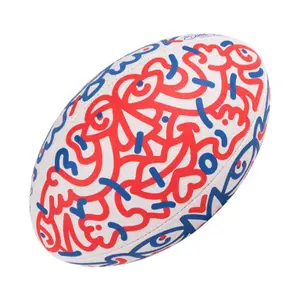
Our Rebond balloons page brings together the rugby balls from the young Nantes brand that entrusts each model to an artist and produces in a more responsible way, between a workshop in Loire-Atlantique and a fair trade certified factory. You will also find our tips for choosing the right size, assessing the grip of a cover, and keeping an artist ball in good condition, whether it is used on the pitch or as decoration.
The match ball, signed Rebond.
Rebond, a Nantes-based brand launched in 2019
Rebond was born in 2019 in Nantes, as a research hub for SGball, the company founded in 2013 by Simon Mutschler and Louis Guillizzoni to design custom balls for clubs and businesses. Its ambition is to demonstrate that a ball can be made without polluting processes. The production relies on a Fair Trade certified factory in India and a workshop set up in a shoe factory in Loire-Atlantique, resulting from three years of research. The brand is working on covers made from bio-based and recycled materials.
The other brands
Match balls are also available in:
All match balls are gathered on the match balls page.
A ball decorated by an artist
Each Rebond ball is entrusted to an artist who designs the decoration: the artwork spans all four panels and transforms the cover into a small canvas, far from standard balls with repeated logos. This choice makes it a decorative object as much as a playing ball, making it a great gift, for example, for a player leaving their club or for a rugby school coach. To preserve the design, many owners reserve their ball for use on dry grass and then display it on a stand away from direct light, which can fade the inks over time.
What the rules require for the match ball
For competitions, World Rugby's law two requires an oval ball with four panels, measuring 280 to 300 millimetres long, weighing 410 to 460 grams, and inflated to between 0.67 and 0.70 kilograms per square centimetre at kick-off. This is the size five, used from around the age of fifteen. The gripped surface makes a difference in the rain: the more pronounced the grips, the more secure the hold. After a match on soft ground, the ball should be rinsed with clear water, dried at room temperature, and have its pressure checked before the next session.
Good deals
Good deals can be found in the good deals, promotions, clearance, sales, Black Friday. The new arrivals showcase the latest collections, and items shipped in 24 hours are prepared and dispatched within 24 hours. The key events of the year follow a stable order: Black Friday in late autumn, the year-end holidays, winter sales, the spring French Days, and then summer sales and back-to-school.
Frequently asked questions
Can a Rebond ball be played like a classic ball?
Yes, it retains the oval shape and dimensions of a rugby ball, and is suitable for passing as well as kicking. However, since the design is the work of an artist, it is best to avoid muddy fields and concrete, which wear it out quickly.
Why is the rebound of the oval ball said to be unpredictable?
Depending on the point of impact with the ground, the oval ball can bounce straight, sideways, or backward. Players learn to anticipate it from their rugby school days, especially on low kicks and dropped balls on the ground.
Does a Rebond ball withstand rain?
It can be played in the rain like a classic ball, but water and mud can wear out the artwork more quickly. If you want to keep the design intact, use it on dry days and wipe it down carefully after each wet match.
What ball size should be chosen for a child?
Before about ten years old, size three is the most manageable; from eleven to fourteen years, size four; from fifteen years old, the adult size five. A ball that's too large for the hand reduces passing accuracy.
How should a decorative ball be stored?
On a stand or in a display case, away from sunny windows and radiators. Slightly deflated, it maintains its shape without stressing the seams, and a dry cloth is enough to remove dust.






