
Match balls Gilbert


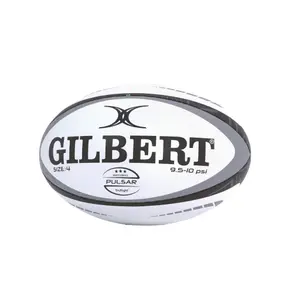
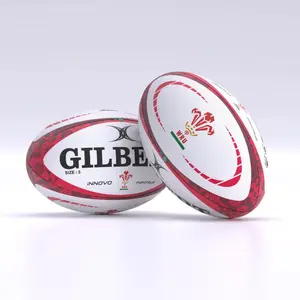


Our Gilbert page is dedicated to match balls from the historic oval manufacturer, the official supplier for every World Cup since 1995. You will find its history, which began in Rugby in 1823, as well as our guidelines for choosing a competition ball: size, coating, grip in the rain, inflation pressure, and maintenance.
The match ball, signed by Gilbert.
From William Gilbert's workshop in Rugby, 1823
William Gilbert, a shoemaker based in Rugby, Warwickshire, is already making balls for the nearby Rugby School in 1823, the year when, according to legend, a student grabs the ball in hand and invents the game. Together with his nephew James, he stitches leather covers around pig bladders. The Gilbert balls are awarded medals at the Great Exhibitions in London in 1851 and 1862, and at the founder's death in 1877, the workshop produces nearly two thousand eight hundred balls a year. This longevity explains why the name Gilbert has become synonymous with rugby balls.
Other brands
Match balls are also available from:
All match balls are brought together on the match balls page.
From leather to synthetic pimples
For more than a century, the rugby ball is made of leather: it gets heavier in the rain by absorbing water and becomes slippery, complicating passes and kicks. Switching to synthentic materials at the end of the twentieth century changes the game: the cover no longer drinks water, retains its weight throughout the match, and features raised pimples that improve grip. Gilbert match balls, like the Kinetica, are based on this principle: a very tacky outer layer, four panels precisely stitched, and a bladder that maintains pressure for a consistent kick trajectory.
The ball of every World Cup since 1995
Since the 1995 tournament in South Africa, Gilbert has supplied the official ball for every Rugby World Cup. Each tournament features a dedicated ball with graphics inspired by the host country, which fans seek out as souvenirs, while clubs enjoy the same technology on amateur fields. For training, the brand offers more durable models, such as the Trainer, whose thick cover can withstand repeated sessions. The match ball, being more fragile, should be reserved for games to keep its grip for as long as possible.
Great deals
Good deals can be found in the good deals, promotions, clearance, sales, and Black Friday. The new arrivals showcase the latest collections, and items shipped within 24h are prepared and sent out in 24 hours. The year's key moments follow a stable order: the Black Friday in late autumn, the festive season, winter sales, French Days in spring, followed by summer sales and back to school.
Frequently asked questions
Which size of Gilbert ball should be chosen based on age?
Size five from around fifteen years old, size four from ten to fourteen years, and size three for under ten years. The same sizing applies to both match balls and training balls from the brand.
Are there size four match balls from Gilbert?
Yes, several match balls from the brand are available in size four for the ten to fourteen age group. They maintain the tacky cover of adult models, getting young players accustomed to the feel of a competitive ball early on.
Can a World Cup ball in supporter version be played with?
Yes, for leisure: it features the graphics of the official ball with a simpler construction. It can be played with among friends or displayed, while the competition model, which is more tacky, is reserved for matches.
Is the Kinetica suitable for daily training?
It's designed for matches, with a very tacky cover that wears out quickly on hard pitches. For repeated sessions, the thicker Trainer from Gilbert is more durable and economical to use.
How to care for a Gilbert match ball?
Clean it with clear water using a soft sponge after each game, let it dry in the open air, and check its pressure before the next match. Stored away from heat, it retains the grip of its pimples for longer.






