
Bike for intense intervals
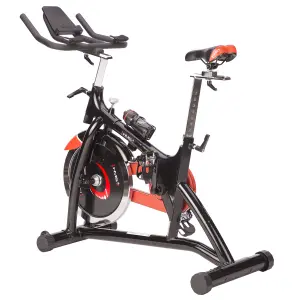


Our cycling bike page brings together models designed for intense cycling sessions: heavy flywheel, sporty position, and adjustable resistance on the fly. It is aimed at the rugby player who wants to work on repeated efforts and leg power at home, with our guidelines for choosing their transmission, braking, and adjusting their position.
Repeated sprints, just like in a game.
From Johnny G's Spinning to the Biking Bike
The biking bike is directly descended from the Spinning program, conceived in 1987 by South African cyclist Johnny G. While preparing for a race across the United States, he wanted to train indoors rather than ride at night, and built himself a stationary bike similar to a road bike. The first centre dedicated to this practice opened in 1989 in Santa Monica, California. The principle hasn’t changed: a heavy flywheel, an adjustable seat and handlebars, and a forward-leaning position allowing you to pedal sitting down or standing up, just like during a climb.
The Other Machines
Cardio also comes in different forms:
All cardio options are available on the cardio page.
Flywheel, Transmission and Braking: The Technical Criteria
On a biking bike, the flywheel usually weighs between fifteen and twenty-two kilos: the heavier it is, the smoother the pedalling is at high cadences. Most models operate on a fixed gear, like a track bike: the wheel keeps driving the pedals when you stop pushing. Hence the importance of the emergency brake, which is activated by pressing on the resistance knob. The belt drive is quieter and requires less maintenance than a chain. The felt brake pads provide a feel similar to the road, while magnetic braking doesn’t wear out and remains discreet.
Sprint Sessions Designed Around Match Rhythm
A rugby match consists of very brief efforts, tackling, rucks, accelerations, separated by incomplete recoveries. The biking bike replicates this pattern without the impacts: sprints of ten to fifteen seconds at high resistance, followed by thirty to forty-five seconds of light pedalling, repeated eight to ten times. This works on the repetition of efforts, a crucial quality at the end of a match. Between sets, a standing climb at high resistance targets the glutes and quadriceps, the muscles for pushing. The seat is adjusted to hip height while standing next to the bike, with the handlebars slightly lower for a forward-leaning torso but a stable back.
Good Deals
Good deals can be found in the good deals, promotions, clearance sales, sales, Black Friday. The new arrivals showcase the latest collections, and items shipped within 24 hours are prepared and dispatched in 24 hours. The major sales events of the year follow a stable order: the Black Friday in late autumn, the end-of-year festivities, the winter sales, the French Days of spring, followed by summer sales and back-to-school promotions.
Frequently Asked Questions
Is a connected biking bike worth it?
It measures power, cadence, and heart rate, and provides access to guided video sessions. For a player following a specific physical training program, this data helps to dose sprints; for general fitness, a classic model with a counter is sufficient.
Do you need specific shoes for biking?
No, strap pedals are compatible with rigid-soled trainers. Mixed pedals, which are compatible with automatic cleats on one side, transmit power better in standing sprints and prevent the foot from slipping.
Biking or exercise bike: which to choose?
The biking bike is suitable for intense sessions, both standing and seated, thanks to its heavy flywheel and sporty position. The exercise bike, which is more comfortable and often equipped with programs, is better suited for endurance training and rehabilitation.
Is biking suitable for a beginner?
Yes, because the resistance can be adjusted freely: you start with twenty-minute sessions at a moderate intensity. The fixed gear requires some adaptation, and you need to learn to slow down gradually rather than just stop pedalling.
How to maintain a biking bike?
Wipe off the sweat after each session, as it can damage the frame and the flywheel. Regularly check the tightness of the pedals and cranks, the tension of the belt, and, on a felt brake, the wear of the pad, which should be replaced as soon as it hardens.






