
FC Grenoble Rugby Balls in the club colours
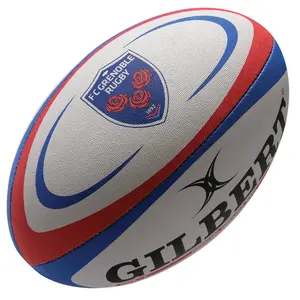

Our page Ballons FC Grenoble Rugby brings together the red and blue balls of the Isère club when they are available, as well as the history of one of the oldest French clubs, from the Mammoths of Jacques Fouroux to the Stade des Alpes, and our tips for choosing the size, inflation and storage of a supporter ball.
The ball of your club, in your hands.
From the 1954 title to Jacques Fouroux's Mammoths
Founded in 1892, FC Grenoble is one of the oldest clubs in French rugby. Its French championship title in 1954 was won against Cognac with a score of five to three, thanks to a try from Lanfranchi converted by Echevet. The club experienced another significant period in the early nineties, when Jacques Fouroux, former captain of the French national team who became a coach, built a powerful pack known as the Mammoths. This team reached the final in 1993, which was lost to Castres after a refereeing error that remains in the memories of all from the Dauphiné.
Other club balls
Club balls are also available in different styles:
- Stade Toulousain Balls.
- Stade Français Balls.
- Racing 92 Balls.
- Castres Olympique Balls.
- ASM Clermont Auvergne Balls.
All club balls can be found on the club balls page.
From Lesdiguières stadium to the Alps stadium
In the early twentieth century, the club moved to a neighboring field near the Lesdiguières hotel, and the Lesdiguières stadium became, for decades, the temple of Grenoble rugby. The FCG played its big matches at the Alps stadium, a venue of around twenty thousand seats opened in 2008 in the Paul-Mistral park, with the surrounding mountains as a backdrop. The red and blue of the club, which is featured on the supporters' balls, can be found in the stands as well as in rugby schools all over Isère.
Choose your red and blue ball according to use
The rules are simple for playing: size five for adults and those over fifteen, size four for ages ten to fourteen, and size three for younger kids. A child registered in a rugby school progresses better with a ball in hand, which they can grip with ease and pass at chest height. For a gift meant to sit on a shelf, a midi size will do and is easier to display. In all cases, inflate the ball with a dampened needle, check the pressure indicated near the valve, and store the ball in a dry place, away from temperature fluctuations in an alpine garage during winter.
Good deals
Good bargains can be found in good deals, promotions, clearance, sales, Black Friday. The new arrivals show the latest collections, and items shipped within 24h are prepared and dispatched in 24 hours. The highlights of the year follow a consistent schedule: Black Friday at the end of autumn, the end-of-year holidays, the winter sales, the French Days in spring, followed by the summer sales and the back-to-school season.
Frequently asked questions
Why were the Grenoble players called the Mammoths?
The nickname referred to the massive and conquering pack built by Jacques Fouroux in the early nineties. These forwards dominated scrums and mauls, which took the FCG to the championship final in 1993.
Why was the Grenoble coach nicknamed the little corporal?
Jacques Fouroux, a small but authoritative scrum-half, earned this nickname due to his leadership temperament. Captain of the French XV during the Grand Slam of 1977, and later national coach, he imposed a very physical forwards game style in Grenoble.
Does a supporter ball hold up on a synthetic pitch?
It can endure a few matches, but synthetic grass wears down the surface and fades the prints faster than natural grass. For regular use on this type of surface, a thick training ball is a more sensible choice.
How to store a ball during the summer break?
Deflate it slightly, clean it, and store it in a dry and temperate place, out of the light. Upon returning, re-inflate it to the indicated pressure and ensure it doesn’t lose air for a few days.
Can you write a name on a rugby ball?
Yes, with a permanent alcohol-based marker, on a clean and degreased surface. For a gift, choose an area without print and let it dry for a few minutes before handling the ball, to prevent the ink from smudging.






