
Children's rugby mouthguards


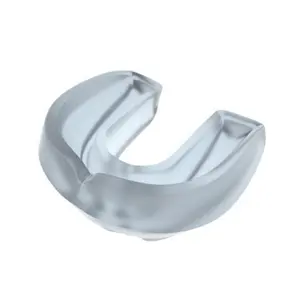


Our selection of children's rugby mouthguards includes thermoformable models from Opro, Safejawz Intro, Makura Toka and Tremblay, the gel mouthguard from Essimo and the Snap-Fit from Opro, ready to wear without moulding. These are suitable protections for the jaws of young players, with our tips on how to mould them, wear them with braces, and maintain them.
The most important protection.
Moulded, pre-formed or gel: models for children
Most models are moulded using the boil and bite method, using hot water. The Safejawz Intro, with a single layer, allows for multiple moulding attempts thanks to its ReModel technology. The Makura Toka, latex-free, features an AirThru channel that makes breathing easier with clenched jaws. The Snap-Fit from Opro comes pre-formed out of the package: it fits onto the teeth without heating, making it handy for beginners or as a backup. The gel model Essimo and the simple Tremblay complete the range in children’s sizes.
Other protections
Children's protections also come in different forms:
All children's protections can be found on the children's protection page.
How to mould a thermoformable mouthguard
Heat water until it simmers and immerse the mouthguard for the time indicated in the instructions, usually for a few seconds, then let it cool a bit to avoid burns. The child places it on the upper teeth, bites down firmly and sucks to press the material against the gums, while pressing with their fingers on the outer surface. Then, it is placed under cold water to set the impression. A good moulding stays in place without the child needing to clench their teeth to keep it secure.
Braces and growth: when to adjust or change
A child wearing braces should not mould a traditional mouthguard too tightly over their brackets: Opro offers a version of the Snap-Fit designed for braces, and the orthodontist's advice remains essential. As baby teeth fall out and permanent ones come in, the impression quickly becomes inaccurate: a mouthguard that shifts when the child speaks or injures the gums needs to be remoulded or replaced. Between sessions, it should be rinsed in cold water and stored in a storage box, away from heat.
Good deals
Great deals can be found in the promotions, sales, clearance, and Black Friday. Items shipped in 24h are prepared and dispatched within 24 hours. The major events of the year follow a consistent order: the Black Friday in late autumn, the end-of-year holidays, the winter sales, the French Days in spring, followed by summer sales and the back-to-school period.
Frequently asked questions
Is a mouthguard required in rugby?
The laws of World Rugby recommend it but do not mandate it, yet many clubs and coaches require it as soon as tackling begins. It's best to consider it an essential part of a young player's gear.
What size mouthguard for a child?
Brands offer a junior size, generally up to ten or eleven years old, and an adult size beyond that. The jaw size determines it: a larger-than-average child may need an adult size earlier.
Is a boxing mouthguard suitable for rugby?
The principle is the same, but rugby requires speaking and breathing while running for long periods: a thinner model at the front, with a breathing channel, is preferred. A very thick boxing mouthguard may hinder announcements.
What is a custom mouthguard?
It is made from an impression taken by a dentist for a perfect fit. In children, whose teeth change rapidly, it needs to be redone regularly, which often limits it to teenagers nearing the end of growth.
What is the purpose of a connected mouthguard?
Equipped with sensors, it measures head impact intensity and alerts the medical staff when an impact exceeds a threshold. World Rugby uses it at the highest level to help in concussion detection; it is not related to children's rugby.






