
Rugby boots Gilbert


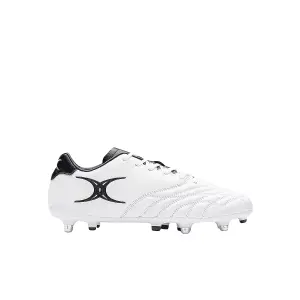
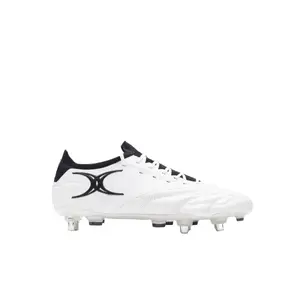


Our page rugby shoes Gilbert brings together models from the English brand born in Rugby, at the foot of Rugby School. Three families share the selection: the Power and the Icon, from forwards' shoes to those for rugby schools, the Kinetica, with a sock-like fit, and the Cage, recognizable by its mesh upper. Six or eight stud options, moulded or hybrid sole: every position finds its pair.
From the ball to the studs.
From William Gilbert's shop to today's studs
Before becoming the most famous name in rugby, Gilbert was a cobbler's business. William Gilbert, a shoemaker whose shop was next to Rugby School, was already supplying the school in the early nineteenth century, and the brand dates its founding to 1823. Its first balls were handmade from four panels of leather stretched over a pig's bladder. So, making rugby shoes brings Gilbert back to its original trade: working with the upper and stitching for the player's foot, with soles designed for English pitches, often waterlogged from autumn to spring.
The Gilbert ranges
The Gilbert shoes come in:
All shoes are gathered on the shoes page.
Power, Kinetica or Cage: three families, three profiles
The Power covers the widest range: with eight aluminium studs and a wider fit, it accommodates props, hookers, second and back row players; its six-stud version targets backs; the Icon, with a moulded sole, serves as a club and school shoe. The Kinetica range features a soft sock-like upper and an integrated strap that locks the foot in at the moment of contact. Finally, the Cage range wraps the foot in a mesh structure for agile players, especially with the Torq and its hybrid sole that combines screw-in and moulded studs.
6S, 8S or MSX: what the Gilbert references say
At Gilbert, the end of a model's name directly indicates the sole type. The mention 8S refers to eight screw-in studs, the configuration for forwards seeking maximum grip. The mention 6S indicates six studs, lighter, for backs who are constantly changing their footing. The acronym MSX corresponds to a moulded stud sole, designed for dry grass and synthetic pitches. On the Power and Kinetica, the BioFrame sole with eight studs combines a structure stabilising the heel and two TPU studs under the forefoot, balancing thrust and acceleration.
Good deals
Good bargains can be found in the good deals, promotions, clearance, sales, Black Friday. The new arrivals showcase the latest models. The highlights of the year follow a steady order: the Black Friday at the end of autumn, the holiday season, the winter sales, the French Days in spring, followed by the summer sales and back to school.
Frequently asked questions
Does Gilbert make shoes for women?
Yes. The Torq is available in a women's version, built on a narrower last at the heel and forefoot. The studs and regulations remain the same: only the fit changes, to better accommodate a narrow foot in the supports.
Which Gilbert shoe for a prop?
The Power with eight screw-in studs: its wider fit allows the foot to spread under load, and its sole remains stable during scrummaging. A prop who often plays on dry ground will keep a second moulded pair.
What replacement studs for a Gilbert screw-in?
Gilbert offers Pro Lite studs in various lengths, from eight to fourteen millimeters, as well as Pro Tip spikes. The longer ones are used on wet pitches and the shorter when the ground firms up, always within the limits set by World Rugby.
Is Gilbert a brand for forwards or backs?
Both. The Power with eight studs and the Kinetica Pro Power target forwards, while the six-stud versions and the Cage Torq are aimed at fast players in the back line. One chooses first according to their position, then according to their pitch.
Is a moulded Gilbert suitable for synthetic pitches?
Yes, that's the purpose of the MSX soles: their short moulded studs distribute the weight on artificial grass just like on dry grass. Models with aluminium studs are often rejected by managers of synthetic pitches.






