
The France rugby shirts


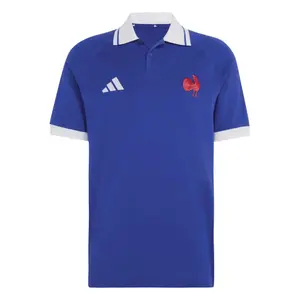


This page brings together the rugby products from France: home and away shirts, authentic versions worn on the pitch, children's models, and official jackets. You will find everything you need to support the Blues in the stands and every day, in all available sizes.
Few shirts tell as much as that of the French XV. Before choosing yours, here is its history, the achievements it represents, and everything you need to know about the cuts and care.
A jersey born with the century
The story begins on 1st January 1906, at the Parc des Princes, when France plays its very first international match against New Zealand. The match clearly goes in favour of the visitors, but it marks the beginning of a team that would never leave the rugby worldwide scene.
A few weeks later, on 22nd March 1906, this time against England, the French players debut a kit that features the three national colours: blue jersey, white shorts and red socks. The blue remained. It has seen all shades over the decades, from the dark, matte blue of thick cotton jerseys to the brighter hues of today's synthetic fabrics, but no collection has ever dared to abandon it. It is from this consistency that the most commonly used nickname for the team comes: les Bleus, often used even before its name is mentioned. They are also referred to as Tricolores, a direct nod to that kit from 1906.
The rooster has occupied the chest for almost as long, and it has become inseparable from the silhouette of the French jersey. Depending on the series, it is embroidered thread by thread or thermofused: the difference is not just about manufacturing, since an embroidered rooster withstands washes without flinching, while a thermofused badge eventually starts to lift at the edges after a few years.
The achievements carried by this jersey
This jersey is one of the most decorated in European rugby. In the Six Nations Tournament, and in the formats that preceded it, France has twenty-eight victories, placing them among the very top nations in the competition.
Ten of these titles are Grand Slams, meaning editions won by winning all matches. They mark the history of the team: first in 1968, then 1977, 1981, 1987, the two consecutive years of 1997 and 1998, then 2002, 2004 and 2006, and finally 2022. This list alone showcases the great generations of French rugby, each having its own jersey, trophy and equipment supplier.
In the World Cup, France holds a less enviable but equally telling record: three finals played, in 1987, 1999 and 2011, with none won. It is the nation that has consistently performed at this level without ever lifting the trophy, which partly explains the public's special attachment to this team.
The team plays at the Stade de France, where the eighty-one thousand seats are filled with blue on Tournament nights. This is the image that most buyers have in mind when choosing their jersey.
adidas, the return of a historic supplier
The jerseys presented here are marked adidas, which has outfitted all French rugby teams since 2024, as part of a contract running until 2028 covering the fourteen national teams.
This is not the first time. The brand with three stripes had already outfitted the Bleus between 1986 and 1998, a period that remains one of their most successful in history as it encompasses the Grand Slams of 1987, 1997 and 1998. It returned the first time between 2012 and 2018, before giving way to Coq Sportif, itself a historic supplier of the team until the mid-1970s and early 1980s.
For a collector, this alternation has a very concrete consequence: jerseys change signature every six to eight years, and a series is never reissued. A jersey picked up upon release is generally not found two collections later.
Home or away: which to choose
Each team has two kits, and the choice between the two is more a matter of taste than technique. The home jersey is the one seen at Stade de France: it features the historic blue and is, by far, the best-selling. It is the obvious choice for anyone wanting the jersey that everyone immediately recognizes, the one filling the stands on match nights.
The away jersey operates under a different logic. As it needs to differentiate from the opponent's colours, it changes dominant shades much more frequently across the series: white, red, grey, sometimes more daring combinations that the competition rules allow. This results in a jersey that is seen much less frequently, which is precisely what many supporters find appealing. If you already own a home jersey, it is generally towards the away one that people turn next.
Both exist in adult and child versions, and an official jacket often completes the collection for those looking for a wearable piece outside of the sports context.
Authentic version or supporter version
This is the most important distinction on the entire page, and the one that causes the most confusion when it is misunderstood. Both jerseys display the same colours, the same rooster and the same supplier, but they are not designed for the same shoulders.
The authentic version replicates exactly what the players wear. It is cut very close to the body, with short, tight sleeves and a dense fabric that doesn’t give any hold for the opponent in contact. This cut responds to a very specific requirement of rugby: a loose jersey offers a grip to the opponent in scrums and tackles, and suppliers have been working for years to reduce this to a minimum. As a result, this jersey is remarkably uncomfortable when you’re not playing. It compresses the arms, rides up on the belly as soon as you raise your hands, and leaves absolutely no ease.
The supporter version includes all the visual elements in a normal cut, with a softer fabric and traditional sleeves. This is the one you should choose in the vast majority of cases: for the stands, for the sofa, for the city. It can be worn on its own in summer or layered over a sweatshirt in winter, something the authentic cut totally prohibits.
Choosing the right size
The sizing logic differs depending on the version chosen, and this is by far the source of the most frequent errors with this type of product.
For an authentic cut, most buyers should size up one size from their usual. The fabric is indeed elastic, but it has been sized for athletes and has no margin: the arm circumference, in particular, remains very tight even when the length fits perfectly. If you’re in doubt between two sizes for this type of jersey, always take the larger one.
For a supporter cut, your usual size is fine. Some even prefer to size up when they plan to wear the jersey over a sweatshirt or fleece, which is often necessary at the stadium between November and March.
Kid's sizes deserve particular attention. They are indicated by age range, but this indication only has approximate value: a child tall for their age will quickly find it tight. The measurement in centimetres, consistently provided by the manufacturer, remains the only reliable point of reference. When in doubt, a size up is no problem, as the supporter cut is already ample by nature.
Making your jersey last
A national team jersey represents a true budget, and it deteriorates quickly when washed like an ordinary t-shirt. However, three precautions are enough to keep it in perfect condition for years.
Washing should be done inside out and at a low temperature, on a gentle cycle. Turning the jersey inside out protects the prints from rubbing against the drum, which is the primary cause of wear on the inscriptions. Hot water, on the other hand, dilates the thermofused elements and gradually lifts them from the edges, starting always from the corners.
The iron must never go directly over a badge, sponsor or number. The thermofusion melts at a temperature that the iron easily reaches, and the damage is irreversible. If ironing is necessary, it should be done inside out, avoiding the printed areas.
The tumble dryer, finally, is to be completely avoided. The heat combined with mechanical agitation detaches badges more surely than any washing. Air drying, ideally flat, preserves the shape of the jersey better than hanging, which eventually marks the shoulders.
The five other nations of the Tournament
The French XV cannot be conceived without its opponents in the Six Nations Tournament, this annual competition that pits the six major European teams against each other and remains the most followed rugby event on the continent. Each has its own page on the site, with its own collections.
- The Ireland plays in green and features the shamrock rather than a flag, as its team encompasses players from the entire island, including Republic and Northern Ireland.
- The England and its white jersey emblazoned with the red rose constitute the oldest national rugby team in the world, and the rivalry with France is the oldest in the Tournament.
- The Scotland is recognized by its deep navy blue and its thistle, a national emblem for centuries.
- The Wales plays in bright red, featuring the leek and the feather, two Welsh symbols found across all its kits.
- The Italy, in azure, is the latest arrival in the tournament and the one whose jerseys are seen the least in France.
All teams are grouped on the VI Nations page, handy for comparing collections from one nation to another before making a decision.
Where to find the best deals
A national team jersey is not a casual purchase, and several sections of the site allow you to find it at a better price without waiting for a particular time. The best deals nations gather current one-off selections, while the clearance nations gathers end-of-line items: jerseys that will not be restocked, often from previous collections, and whose common sizes always go first.
Commercial highlights follow in a steady order throughout the year. The Black Friday marks the end of autumn, followed by the year-end holidays, during which the jersey ranks high on gift lists. Then come the winter sales, which coincide right when the Tournament starts, followed by the French Days in spring.
Frequently asked questions
Since when has the French XV played in blue?
Since 22nd March 1906, when the team debuted a kit against England featuring the three national colours: blue jersey, white shorts and red socks. The first official match of the team had taken place a few weeks earlier, on 1st January 1906, against New Zealand at the Parc des Princes.
What is the record of the Bleus?
France has twenty-eight victories in the Tournament, including ten Grand Slams: 1968, 1977, 1981, 1987, 1997, 1998, 2002, 2004, 2006 and 2022. In the World Cup, it has played three finals, in 1987, 1999 and 2011, without ever winning.
What is the difference between an authentic jersey and a supporter jersey?
The authentic version is the fit worn on the pitch: very fitted, with tight sleeves and a dense fabric that gives no hold to the opponent in contact. It is quite uncomfortable when not playing. The supporter version features exactly the same colours and rooster in a regular fit, much more pleasant for everyday wear.
Should I size up?
For an authentic fit, yes, in most cases: the fabric is stretchy but has no margin, and the arm circumference remains very tight. For a supporter fit, your usual size is fine, unless you plan to wear the jersey over a sweatshirt at the stadium.
Why do some badges come off?
Because they are thermofused rather than embroidered, and heat detaches them. The tumble dryer is the main cause, followed by the iron going directly over the badge and high-temperature washes. An embroidered rooster does not have this problem.






